
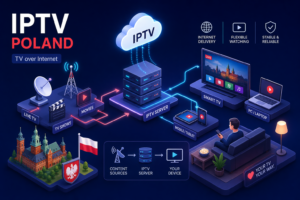
Picture this: it’s Sunday evening in Paris, you’ve settled in after a long week, and all you want is to catch the late news on TVP1, check the Ekstraklasa scoreline, or pick up that Polsat series you’ve been following. You grab the remote, flip through your French cable box, and find nothing. Not because Polish television doesn’t exist, but because your provider simply doesn’t carry it. That gap is exactly what IPTV Poland was built to close.
IPTV, or Internet Protocol Television, delivers live channels and on-demand content over your regular broadband connection rather than through a satellite dish or cable wire. For Polish expats in France, that means full access to the channels, sports coverage, and programmes you grew up with, on the screens you already own. This guide walks you through how the technology works, what a complete service should include, how to tell a legitimate provider from a risky one, and which devices you can use to get started tonight. Where it makes sense, I’ll point you toward Poland IPTV (IPTV Polska), a service built specifically for the Polish community in France.
How IPTV Poland technology delivers Polish channels to your screen
Traditional satellite TV works by capturing a broadcast signal beamed down from orbit, which is why you need a dish pointed at a specific position in the sky. IPTV works completely differently. Instead of a broadcast signal, your provider sends television content as data packets across the internet, from its servers directly to your device. When you press play on TVP2 or TVN24 from your apartment in Lyon, your device connects to the provider’s server, pulls the live stream in real time, and decodes it using a codec like H.264 or H.265.
The quality of that picture depends on the server infrastructure on the provider’s end and the stability of your own internet connection, not the direction your window faces. The delivery path goes roughly like this: a Polish broadcaster produces its content, a licensed IPTV provider encodes and distributes the signal through its server network, and the stream reaches your app or set-top box over broadband. This is why a solid Polish TV streaming service can reach you whether you’re in Strasbourg, Lille, or anywhere else in Europe with a reliable connection.
Live TV, replay, and VOD: what each mode actually means
What a complete IPTV Poland service includes
Before subscribing to anything, it’s worth knowing what the channel landscape should look like. A strong service covers the full range of Polish broadcasting: national public channels, commercial networks, rolling news, regional, sport, and children’s programming. If a provider’s catalogue feels thin in any of those areas, that’s a sign worth noting.
The Polish channels that matter most
EPG, replay, and the features that make daily use smooth
IPTV Poland: the service built for the French-Polish community
Why specialisation beats a generic catalogue
What is included and how to get started
How to choose a legitimate Polish IPTV subscription
The legal line: licensed versus unlicensed services
Red flags that signal a high-risk provider
Device compatibility and getting set up
Smart TVs, MAG boxes, and Amazon Firestick
Smartphones, tablets, and browser access
Getting a stable, buffer-free stream every time
Speed benchmarks for HD and 4K Polish channels
Simple fixes when the picture freezes or drops
Ready to watch Polish TV from France tonight